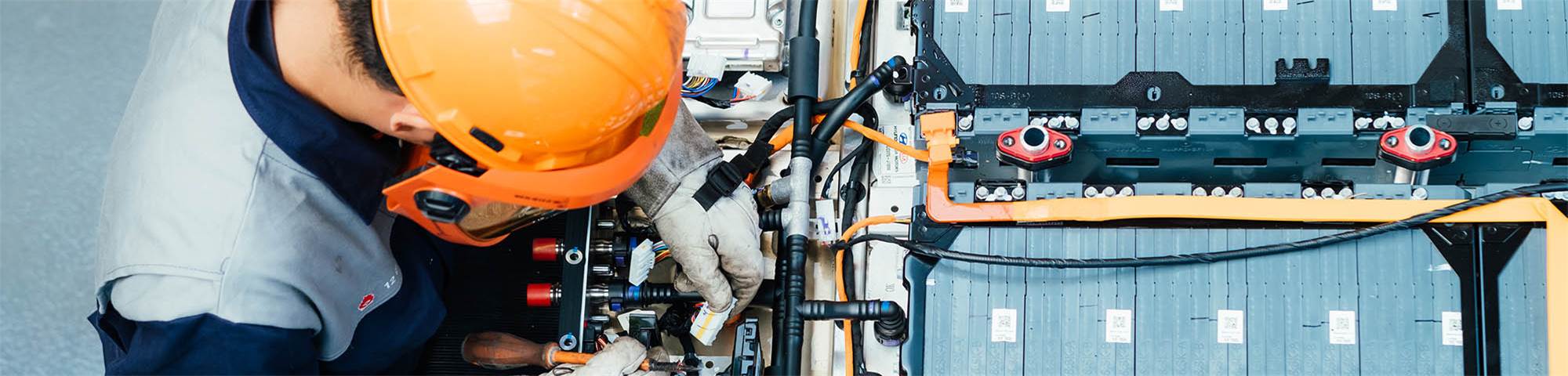
Experts in the recycling, dismantling, transportation and storage of lithium-ion batteries
Trusted reliable service
Over 5 years experience
Expert and experienced team
As the popularity of electric vehicles and the use of the lithium battery continues with more and more people making the switch to the new normal, the volume of expired lithium batteries will gradually increase. Unlike traditional lead-acid batteries, lithium batteries pose a significant fire risk, are more difficult to recycle and need to be handled extremely carefully by registered specialists.
Currently there are very few companies in the UK that offer this service. Our aim is to help businesses and individuals safely dispose of lithium batteries, whilst ensuring that all recoverable elements can be recycled for re-use in future battery production.
Our services
Fully licensed lithium battery disposal
Fully compliant transportation service
Workshop-based recycling of lithium elements
Recycling
Lithium batteries contain raw elements such as nickel and cobalt which, as a finite resource, are extremely valuable in lithium battery production. Adopting a sustainable approach ensures these elements can be recovered and recycled.
The dismantling of lithium batteries is not a simple process and needs to be carried out by highly trained experts. Our specialist workshop allows for our approved dismantlers to safely extract all the valuable elements for full recycling at approved production facilities.
Treatment
If you are a manufacturer, R&D facility or breakers yard, the volume of damaged or end of life electric vehicles you receive will increase dramatically over the next 5-10 years, you may even receive a small number now.
With this in mind, it pays to plan ahead. Our service will collect and dispose of any lithium batteries you find in your possession safely and securely. Our expert consultants can discuss your disposal needs and help you compliantly store or ship your battery to our approved facility.
Re-use and second life
A battery in such a supply is not required to give up power in quick bursts like you would need in a car going up-hill or overtaking, instead, the steady nature of being charged and discharged in a more gentle fashion means the lithium battery can serve for an extended period and have a valid use.
ADR transportation
Lithium batteries are a significant fire risk and are classed as dangerous goods when it comes to transportation, even used batteries that are at the end of their life contain charge and need to be handled extremely carefully. We have all the necessary dangerous goods transportation licences and specialist vehicles that are fully equipped to move used batteries between facilities.
Our team of experts can prepare the batteries for transportation, package them safely, and ensure they get to their end destination with minimal risk.
ADR approved packaging
Consultancy and assessment
Our experts can provide a full consultancy service with help and advice on all aspects of lithium-ion battery storage, transportation and recycling. With specialists in lithium battery dismantling and our very own state of the art workshop, we have all the required tools and facilities to safely discharge and dismantle used and damaged batteries to extract as many re-usable cells as possible.
Our team can be contacted for an online, telephone or in person consultation to discuss all of your one-off or on-going lithium battery disposal needs.
The sectors we serve
Car manufacturing
The issue of how to process and dispose of used lithium-batteries is a real challenge for electric car manufacturers and OEMs. Lithium batteries can be highly flammable and are therefore represent a significant fire risk, particularly if multiple numbers are kept in storage.
Car manufacturers have been at the heart of the electric vehicle revolution over the last decade and as lithium batteries have evolved, so too has the viability of electrically powered transport, both in terms of charge longevity and power. Although the end of life market for EVs may still be in its infancy at present, the volume of damaged and expired lithium batteries being returned to manufacturers is likely to expand dramatically and quickly. Even now, many EV manufacturers will have received a steady trickle of these vehicles due to warranty issues, crash or fire damage.
The avenues currently available to deal with these lithium-ion batteries is still fairly limited, and we are one of the very few organisations that are thoroughly equipped and regulated to deal with them.
Here at SUEZ, we can provide a full consultation on all of your lithium battery disposal needs. From fireproof storage boxes to hire or buy, to transportation and fully dismantling and recycling in our specialist workshop, we have the full range of services to eliminate the challenge of expired lithium vehicle batteries.
Leisure and mobility
When it comes to powering leisure and mobility scooters, lithium batteries have a lot to offer. They are much lighter than lead-acid batteries and therefore much easier to remove and charge. They also charge much faster than traditional batteries and last longer.
As the popularity of electric power in the mobility sector grows, so to will the volume of used lithium batteries that need to be disposed of. Retailers, dealers and manufacturers will begin to receive end of life electric goods and will need a safe way to deal with the lithium-ion batteries that power them. Logically, the best way to do so is to involve the experts from the start. At SUEZ, we not only safely store and transport lithium batteries, but we are also specialists in dismantling them and recovering and recycling the valuable cells within them.
As well as cars, scooters and boats are also an increasing market for electric power. We have already seen a huge surge in the sale and use of electric scooters since lockdown, and this trend is set to continue. Both boat and scooter manufacturers will, in time, be in receipt of used or damaged electric boats and scooters and at this point, it is vital to have the right processes in place to deal with the damaged or worn out lithium-ion batteries that power them.
We can provide a collection, storage and dismantling service for used batteries which will ensure they are properly recycled to recover vital elements to be re-used in the production cycle of new batteries.
Back up systems
With our reliance on power, especially with data storage, the use of lithium-ion battery within back-up power systems is widespread.
From sub-stations to back up entire grid networks to small individual server or device back up power units, there are is an increasing demand for the solution to deal with the end-of-life batteries.
SUEZ can provide a collection, storage and dismantling service for used batteries which will ensure they are property recycled to recover vital elements to be re-used in the production cycle of new batteries.
Research and development
The success of electric vehicles can be attributed in part to the many expert R&D facilities based here in the UK. Sites such as UKBIC, Horiba MIRA and UTAC Millbrook Proving Ground have been fundamental in the evolution of lithium-ion batteries and their capabilities.
The research and development process naturally involves many tests and trials, and damaged batteries are a natural waste stream from this process. SUEZ are one of the few organisations that offer a full solution for all damaged and expired lithium batteries. This includes advice and equipment for safe storage, compliant transportation with a dangerous goods licence and full dismantling for ethical recycling in our specialist lithium battery workshop.
Industrial battery applications
Electric power isn’t limited to vehicles and the use of industrial applications for lithium power is increasing rapidly with the upgrades of automation and technology advances.
From larger fixed equipment, to batteries from smaller hand-held devices such as power tools, radios and monitoring equipment, all types of organisations are reaping the benefits of working with machinery that is powered by lithium-ion batteries. However, like vehicle manufacturers and retailers, those who deal with machinery of this type must be properly equipped to receive the old batteries back into their facilities.
Electric plant vehicles and trucks are already on the increase and it is only a matter of time before electric tractors, cranes, diggers and dumper trucks will become the norm. Manufacturers of this type of vehicle will, in time, be in receipt of used or damaged electric plant vehicles. At this point it is vital to have the right processes in place to deal with the end-of-life lithium-ion batteries.
SUEZ can provide a collection, storage and dismantling service for used batteries which will ensure they are property recycled to recover vital elements to be re-used in the production cycle of new batteries.
Automated treatment facilities
Whether your ATF is classed as a breakers yard or scrap dealership, the likelihood is that you’re dealing with end of life vehicles and it’s only a matter of time before some of these vehicles include electric cars powered by lithium-ion batteries.
Unlike lead-acid batteries, their lithium counterparts pose a significant fire risk and need specialist treatment. Storage can represent a challenge from a health and safety perspective, and it is vital that they are dealt with compliantly. Some ATFs are reluctant to accept electric vehicles, but this does not have to be the case. SUEZ are one of the few organisations to offer a full solution for all damaged and expired lithium batteries. This includes advice and equipment for safe storage, compliant transportation with a dangerous goods licence and full dismantling for ethical recycling in our specialist lithium battery workshop.